Lectures 2026
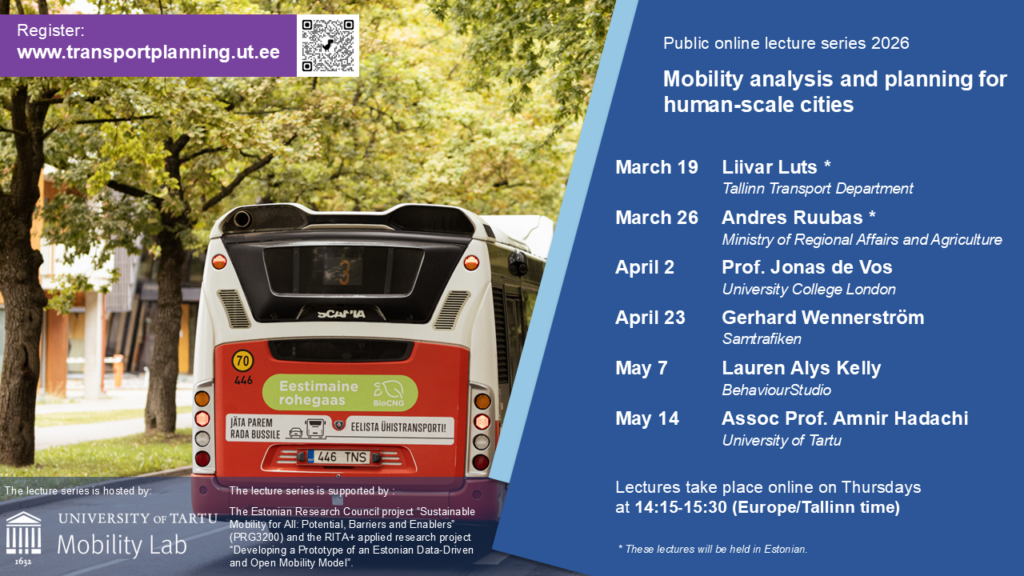
Public online lecture series “Mobility analysis and planning for human-scale cities” 2026
The lecture series organised by the Mobility Lab of the University of Tartu explores how the analysis and planning of mobility data can support the development of sustainable travel behaviour and shaping high‑quality urban environments. A further objective of the series is to contribute to the training and professional growth of future mobility specialists. The lectures address transport policy; transport and urban planning; the management of social change; the social, environmental, and health dimensions of transport and mobility; the concept of accessibility; travel demand and travel behaviour; and emerging datasets and analytical methods in mobility studies and transport planning.
In 2026, the lecture series will take place for the fifth time. This year’s focus is on public transport. The programme will examine national and municipal approaches to the planning and management of public transport; passenger satisfaction and the shaping of public transport use through targeted interventions; collaboration between service providers in delivering journey‑planning and ticketing solutions; and the use of mobility data in modelling multimodal urban travel.
Register to the 2026 lecture series here. All participants will receive a Zoom link in the week of the lecture at the latest.
The lecture series is part of the graduate-level course “Mobility Analysis for Planning” in the Geography study programme at the University of Tartu. Live online lectures and their recordings are public and accessible to everyone. Some of the lectures are held in Estonian.
Lecture series is supported by the Estonian Research Council-funded project “SMob4All: Sustainable Mobility for All: Potential, Barriers, Enablers” (PRG3200) and RITA+ programme project “LAAM: Developing a Prototype for a Data-Driven and Open Mobility Model for Estonia”. the The technical implementation of the lectures is carried out by the visual media service of the University of Tartu.
More information: Siiri Silm (siiri.silm [@] ut.ee) and Age Poom (age.poom [@] ut.ee).
Mobility Lab of the University of Tartu
Organised by:

Technical implementation:


Liivar Luts
Tallinn Transport Department
Tallinn’s public transport as the backbone of urban mobility – from strategies to practical implementation
March 19, 14:15–15:30 (UTC+02:00) (The lecture will be in Estonian.)
The lecture will present recent developments in Tallinn’s public transport system in the context of the objectives set out in the Sustainable Urban Mobility Plan 2035 and the development strategy “Tallinn 2035”. It will outline how the renewal of Tallinn’s public transport network takes into account population distribution, public transport usage data, mobility surveys, traffic data, as well as mobile positioning data and origin–destination demand matrices provided by the Tax and Customs Board. The lecture will provide a comprehensive overview of how data-driven decision-making has guided the development of public transport in Tallinn over the past several years, shaping both strategic planning and practical implementation.
Liivar Luts is a mobility engineer and Head of the Strategic Mobility Planning Department at the Tallinn Transport Department. Through his work, he contributes to the strategic management of Tallinn’s mobility sector and to shaping the city’s mobility future. Liivar is one of the co-authors of the “Tallinn Sustainable Urban Mobility Plan 2035” and has been involved in the development and implementation of strategic mobility policy documents. His aim is to create a modern urban space with a balanced mix of transport modes.
To be added.

Andres Ruubas
Ministry of Regional Affairs and Agriculture
Public transport organisation in Estonia: from a strategic perspective to the implementation of solutions
March 26, 14:15–15:30 (UTC+02:00) (The lecture will be in Estonian.)
The lecture will address the key principles for planning public transport services and service levels, as well as the indicators designed to assess their performance and effectiveness. It will provide an overview of the organisation of public transport and the most important strategic documents guiding its development. The lecture will also introduce the public transport reform and its implementation action plan, present the analysis of a clockface-based integrated public transport network, and outline both the development process and the results achieved.
Andres Ruubas works at the Ministry of Regional Affairs and Agriculture as Head of the Public Transport Department. In 2022, he joined the Transport Administration to lead its Public Transport Department; however, from 2023 onwards, responsibility for organising domestic public transport and developing public transport policy was transferred from the Transport Administration to the Ministry of Regional Affairs and Agriculture. Prior to entering the field of public transport, Andres worked on issues related to the free movement of services at the Ministry of Economic Affairs and Communications. Andres graduated from Tallinn University of Technology with a degree in Public Administration.
To be added.
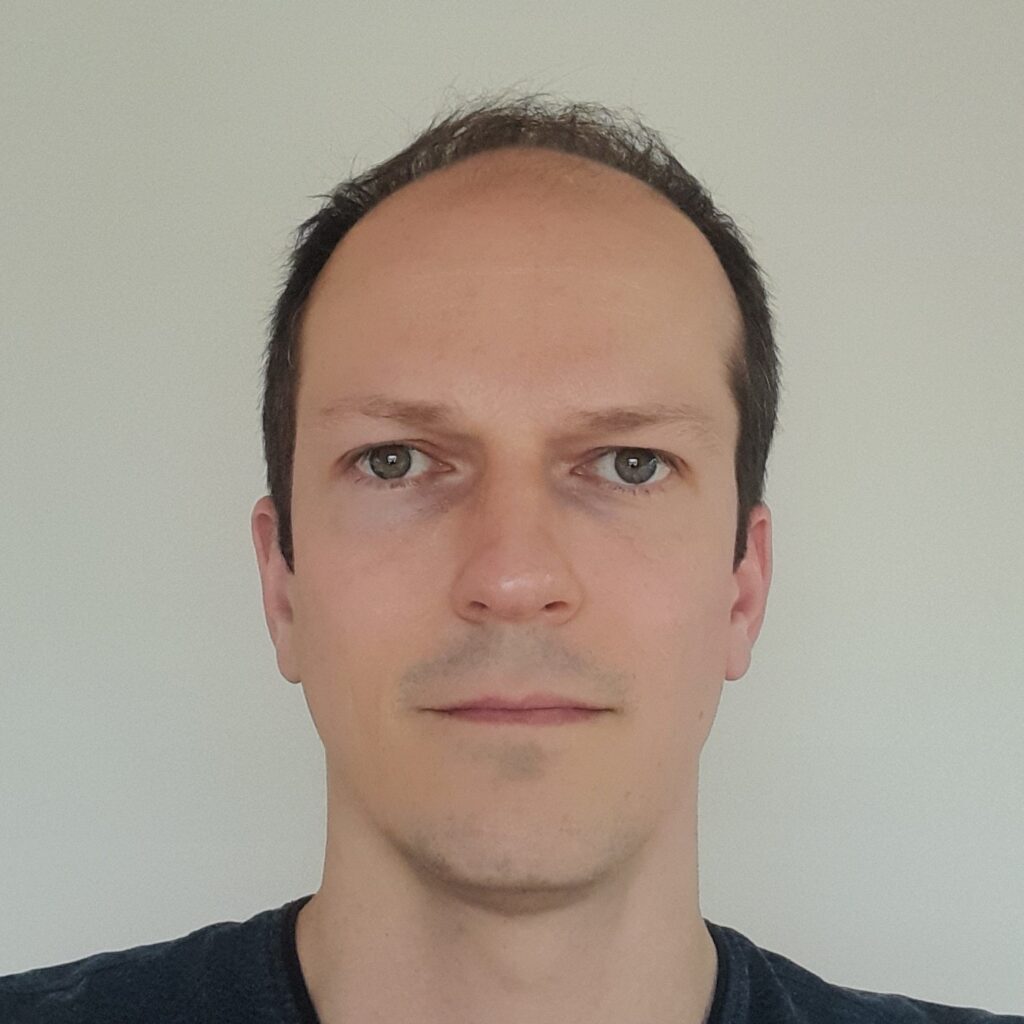
Professor Jonas de Vos
University College London
Determinants of travel satisfaction: from travel mode to perceptions
April 2, 14:15–15:30 (UTC+03:00)
In this lecture, Jonas de Vos will give an overview of existing studies analysing travel satisfaction, based on his research in Ghent (Belgium) and London (UK), and research from other travel behaviour academics worldwide. He will describe travel-satisfaction measures and show that travel satisfaction is strongly influenced by travel duration and travel mode. Additionally, Jonas will indicate how satisfaction with travel may be influenced by transport equity and perceived accessibility.
Jonas De Vos is a Professor of Transport Planning at the Bartlett School of Planning, UCL. He obtained his master’s degrees in Geography (2010) and Urbanism and Spatial Planning (2011), and a doctoral degree in Geography (2015) at Ghent University. Jonas’ research focuses on travel behaviour, particularly on the links between travel and well-being, and travel and land use. He has published over 100 peer-reviewed journal articles and has been listed as a highly cited researcher by Clarivate in 2024 and 2025. Jonas is co-editor-in-chief of Transport Reviews and an editorial board member of Transportation Research Part A, D and F, Journal of Transport Geography, Travel Behaviour and Society, and Transportation. He is currently the chair of the World Society for Transport and Land Use Research (WSTLUR).
To be added.
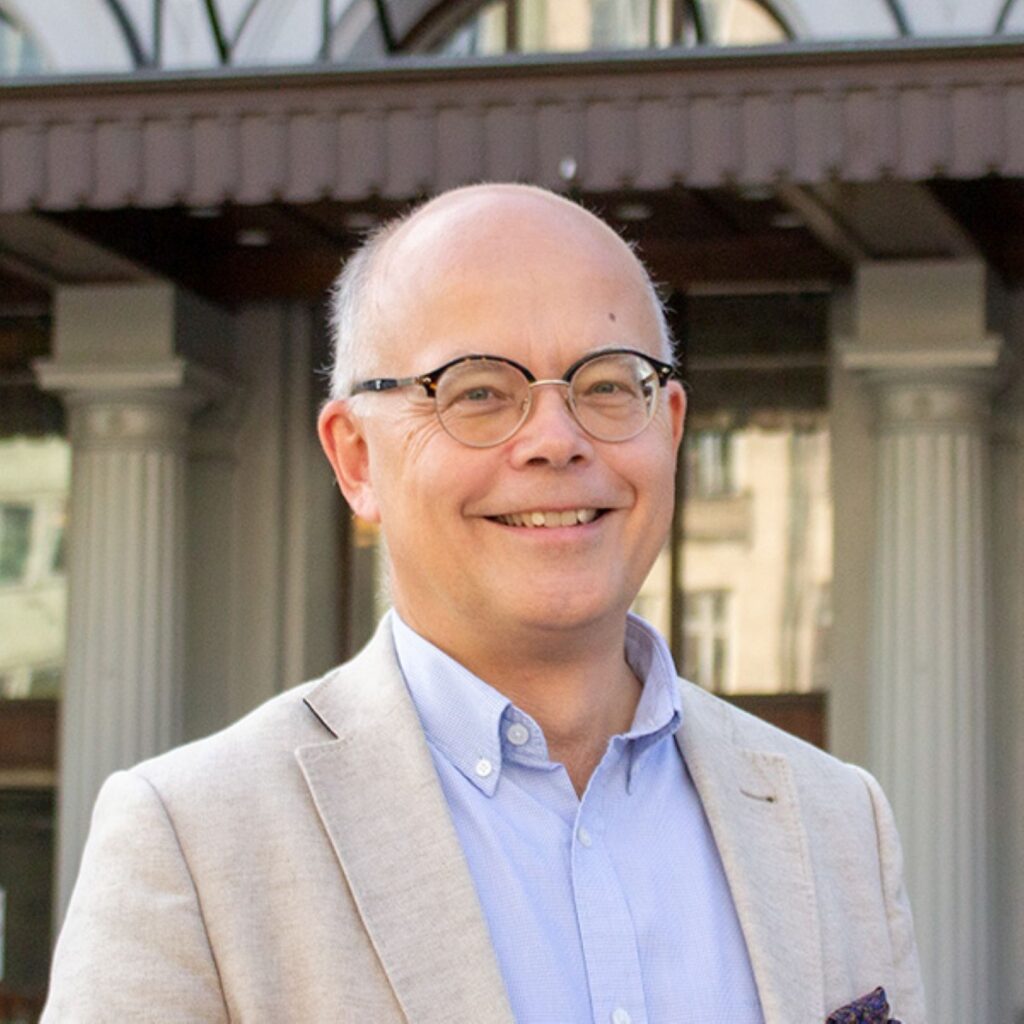
Gerhard Wennerström
Samtrafiken
Interoperable ticketing and the realities of shared sales in public transport
April 23, 14:15–15:30 (UTC+03:00)
The lecture will address the ongoing digital integration of public transport booking and ticketing systems, shaped by EU regulation, emerging technical standards and increasing customer expectations. At the same time, it will examine the structural constraints created by existing business models, shared sales agreements and economic interdependencies, which are often underestimated in policy and planning discussions. Focusing on practical experience from Sweden, the lecture will explore the realities of interoperable ticketing, including shared sales models, governance structures and the balance between technical feasibility and commercial viability. It will highlight the key challenges that arise when multiple actors, incentives and responsibilities must be aligned across the public transport ecosystem.
Gerhard Wennerström is Managing Director of Samtrafiken, the Swedish organisation responsible for coordinating nationwide public transport ticketing and shared sales solutions. He has extensive experience in public transport governance, digital ticketing, and inter-organisational collaboration. Gerhard’s work focuses on aligning technical standards, commercial models, and regulatory requirements to enable seamless travel across operators and regions, while addressing the structural and economic complexities of shared public transport systems.
To be added.

Lauren Alys Kelly
BehaviourStudio
Why the car keeps winning (and how to change that)
May 7, 14:15–16:30 (UTC+03:00)
Public transport systems shape behaviour every day through built-in choice architecture: fare rules, ticketing flows, journey planners, station cues, and service communications. This lecture offers a practitioner’s view of how to spot these behavioural levers and redesign them to support shifts towards walking, cycling, and public transport. Using a simple framework (policy, product, place, operations), The lecture will examine how small design choices shape decisions throughout a real journey, from planning and payment to navigation, waiting, and disruption.
Lauren Alys Kelly is a behavioural strategist and designer, and the founder of BehaviourStudio. She helps organisations turn smart plans into real follow-through, especially when people are busy, sceptical, or stuck in old habits. Her work turns behavioural science into practical systems teams can use, like toolkits, sprints, and playbooks that make the right action easier in the moment it matters. She has worked across public and private sector projects and trained many teams. With clients including Meta, Microsoft, Accenture, PwC, and Manchester Metropolitan University.
To be added.
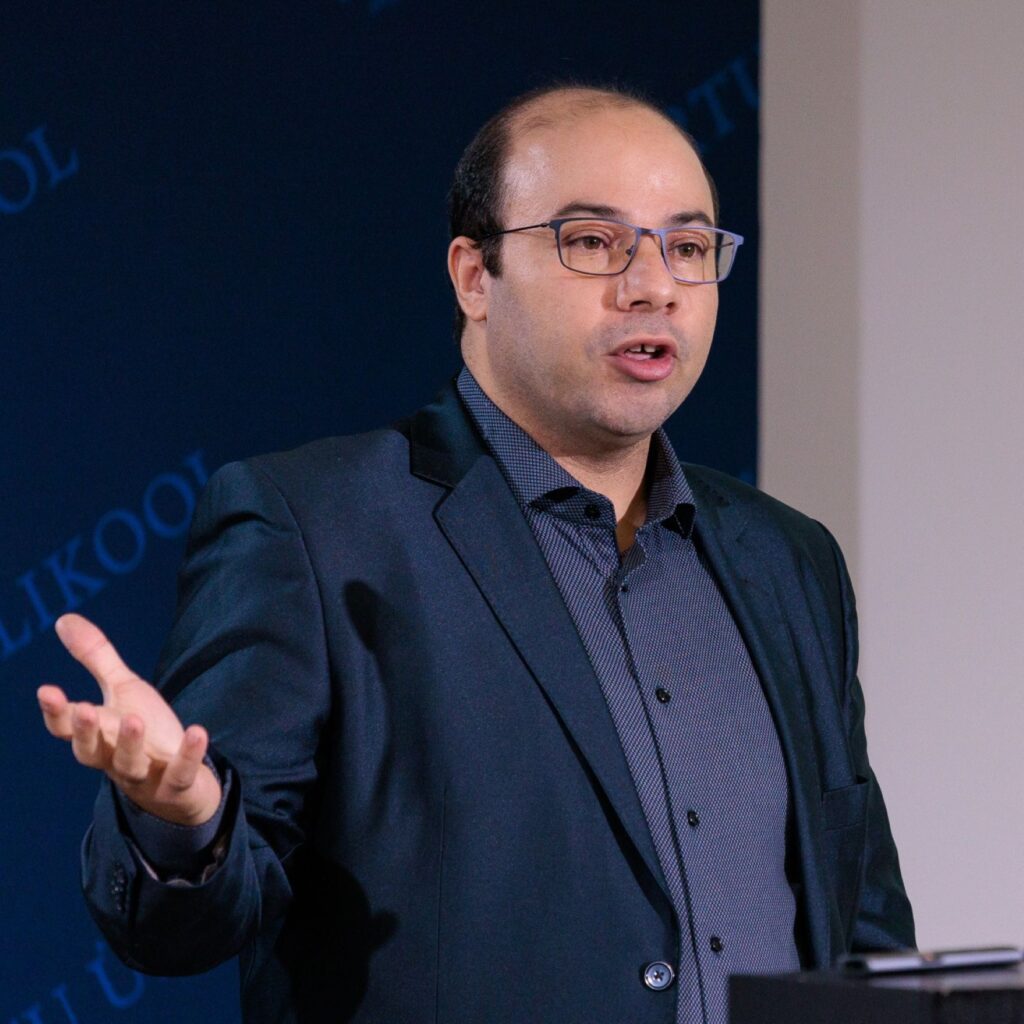
Associate Professor Amnir Hadachi
University of Tartu
Multi-modal modelling of urban mobility: from data to decisions
May 14, 14:15–16:30 (UTC+03:00)
The lecture will examine how urban mobility has become increasingly multi-layered, data-intensive and closely intertwined with policy decisions. It will highlight how cities are no longer shaped by single-mode transport systems, but by complex interactions between walking, cycling, public transport, private vehicles, shared mobility and emerging on-demand services. The lecture will explore how multi-modal models move beyond abstract demand estimation to support evidence-based urban planning, infrastructure development and policy impact assessment. It will position multi-modal modelling within a broader research framework that connects theory, data, computation and governance, while emphasising its practical implications for creating sustainable, efficient and equitable mobility systems.
Dr Amnir Hadachi is an Associate Professor of Smart City Technologies and Head of the Chair at the University of Tartu, where he leads the Intelligent Transportation Systems (ITS) Lab and advances research at the intersection of artificial intelligence, mobility analytics, and sustainable urban innovation. Holding a PhD in Computer Science from INSA Rouen (France), he specialises in spatio-temporal data analytics, intelligent transportation systems, mobility modelling, and applied machine learning, transforming large-scale urban data into actionable solutions for smarter, greener cities. He collaborates closely with industry and public-sector partners, contributes to European innovation initiatives, and serves as Associate Editor of the Journal of Urban Mobility (Elsevier). Dr Hadachi has authored numerous peer-reviewed publications and actively shapes the future of data-driven urban mobility and intelligent infrastructure systems.
To be added.